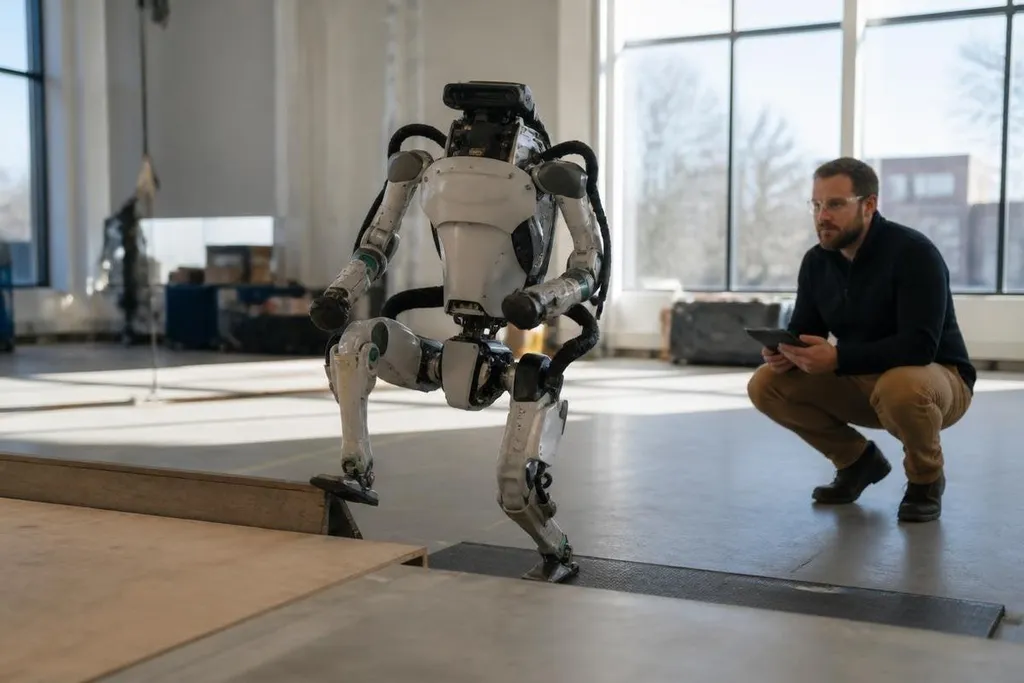
In software, a robot can repeat a task thousands of times, then fail on the first uneven floor. The next stage of robot training will depend on closing that gap between controlled practice and physical work.
This matters to the engineer choosing a training method, the operations manager judging a pilot, and the buyer deciding which claims deserve money.
- Simulation can produce many practice runs without wearing out hardware.
- Teleoperation gives a robot examples of how people handle uncertain tasks.
- A training result matters only when it holds up on the target robot, in the target place.
What robots need to learn
Training requires more than a list of instructions. It needs to connect what its sensors see with the movement that follows. A camera may show a box, while force sensors tell the robot whether its gripper has made contact.
That link is difficult because the same task changes from one attempt to the next. A soft package bends. A shelf shifts. A person may place an item at a different angle. Training data has to include enough of these changes for the robot to respond without a new command each time.
The data can come from several places. Engineers can record people guiding the robot, collect sensor readings from earlier jobs, or create practice scenes in simulation.
Each source gives a different view of the task, so the training plan needs a clear link to the work the robot will actually do.
Simulation helps, but the floor still decides
Simulation lets a team test control software before it puts a robot near people or equipment. It can also repeat rare situations that would be hard to arrange safely, such as a dropped object or a blocked route.
The problem is that a simulated sensor, surface, or object may behave differently from its physical version. A model can learn to move well under one set of assumptions and then miss when lighting changes or a wheel loses grip.
That makes the transfer step a separate test. The team needs to compare the simulated result with physical trials, record where the two differ, and adjust the model or the training data. A high score inside simulation does not settle the question.
The gap between simulation and physical trials makes human guidance part of the record. Dated robotics reporting from Robot24.com can place the robot, company, test date, and deployment beside each training claim before people take over when the model reaches its limit.
Human guidance will remain part of the process
People can give useful examples when a task contains judgment or physical uncertainty. During teleoperation, a person may guide the robot around an obstacle, correct a grasp, or stop the system before contact causes damage.
Those actions are useful data, though they are not perfect instructions. A person may move faster than the robot can, rely on sight that the robot lacks, or correct a mistake without recording why the correction was needed.
Training systems will need to save more than the final movement. They should keep the sensor view, the robot’s action, the result, and any stop or correction. That record gives engineers a way to find the failure rather than guessing from a successful video.
I’d judge a training claim by the test that follows it: the same task, the same failure rules, and a clear record of what the robot could not do.
What remains unproven
Learning one task may still require separate work for another. Picking a box does not prove that it can load a shelf, and moving across a room does not prove that it can work safely beside staff.
The cost of training also includes setup, data cleanup, software checks, downtime, and repeated physical trials. A model may be quick to run after training, while the work needed to create reliable training data takes much longer.
The largest open question is how much new data a robot needs after its surroundings change. A useful system should show when its old training no longer fits, then give people a safe way to correct it.
A practical check before buying
Use these questions when a vendor presents a robot training result:
- Task match: Was the robot trained on the same object, surface, speed, and work area you use?
- Physical proof: Did the result come from the actual robot, or from simulation alone?
- Failure record: Does the report show dropped items, stops, collisions, and failed attempts?
- Human input: Can a technician correct the robot without rebuilding the whole system?
- Change test: What happens when lighting, object position, or floor conditions shift?
The next useful training system will be judged less by the number of simulated runs than by the evidence after conditions change. Until vendors publish that evidence, treat smooth demonstrations as a starting point, not a work-ready result.